Metal Self-Storage Buildings for Wyoming Operators
Less than 3 percent of land in Teton County is privately owned, and the average Jackson home was listed near $1.9 million in late 2025, so a person who lives there has very little room for toys, tools or seasonal gear. That is the whole self-storage business in one sentence: people have stuff and not enough space. Wyoming is a state of boats, snowmobiles, side-by-sides, campers and ranch trucks, and storage owners here build for those vehicles as much as for boxes.
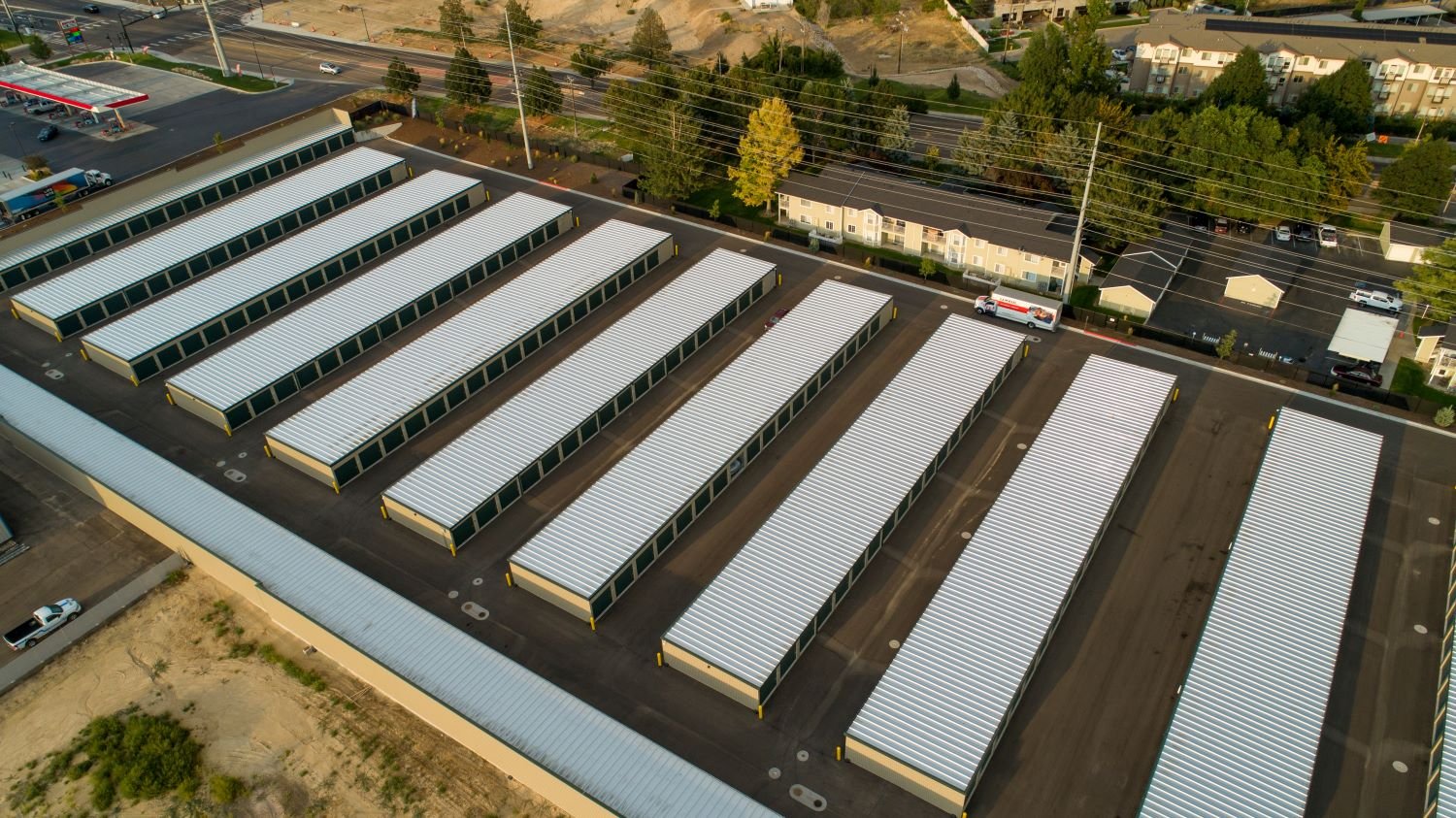
We build storage buildings on pre-engineered steel for operators who want a low cost per rentable square foot and a short build. Drive-up rows, climate-controlled blocks, RV and boat bays, and a small office with a manager unit are all standard. The steel frame repeats from one building to the next, which is why the second and third phases cost less to build than the first.
Our buyers are first-time owners with a single lot, regional operators adding sites, and developers who build and sell to a manager. If you have a parcel and a unit mix in mind, start with self-storage metal buildings and our self-storage facility layouts, then send us your site dimensions for a price.
What drives cost per rentable foot
The big-ticket items in a drive-up building are the roll-up doors, the slab and the roofing. Doors are the largest line in many projects, because every unit has one. Corridor width, wall height and the share of floor area that is rentable decide how much steel you pay for per rentable square foot. A standard 10 by 20 unit is more efficient than a 5 by 5, and a building of fewer, longer rows saves foundation and trim.
Climate control adds insulation, interior partitions, heat and sometimes cooling, and it is worth it only if rents in your market support the premium. Snow load pushes the price too, and a drive-up row with an eave facing the drive aisle sheds snow where customers walk, so we plan roof direction and gutters with that in mind. We price the shell, the doors and the site separately so you can test different unit mixes quickly.
Where demand shows up in Wyoming
Storage follows people, not just population. Bar Nunn grew about 35 percent, from 2,213 residents in 2010 to 2,981 in 2020, and Mills grew from 3,461 to 4,034 over the same decade. Both sit in the Casper metropolitan area, and growing bedroom communities on the edge of a city are where new storage tends to succeed. Evansville, in the same metro area, grew from 2,544 to 2,746.
Tourist towns work differently. Cody is the nearest town to Yellowstone's east entrance and sees seasonal traffic, and Jackson has limited land and expensive housing. Owners there rent to residents with seasonal gear and to businesses that need a place for inventory. We help you size a first phase to local rents and leave room to add. A small town can support a small building well, and a bigger one can wait.
Site and layout decisions that matter
Most storage projects succeed or fail on the lot. Access to a main road, visibility from traffic, turning room for a moving truck and drainage all matter more than the building. We lay out rows so a 26 foot truck can turn without hitting a door, and we grade the lot so water leaves the aisles. Fire access is part of the plan and the local fire authority will want to see it.
Then plan for growth. Build the first rows with the utilities and gate infrastructure sized for the final site, and design the end walls so a row can extend later. Owners who do this add buildings quickly when the first phase fills. Operators who also rent outdoor and covered spaces for vehicles can look at our work for automotive and fleet users, where vehicle bays and tall doors are routine.
Roofs, retrofits and upgrades
Many storage owners start with a used building. If you bought a facility with old panels, leaks or stuck doors, a re-skin can be cheaper than a rebuild. See our re-skin, retrofit and repair work for how we replace panels over an existing frame. New buildings can also use standing seam metal roofing, which has concealed fasteners and tolerates thermal movement better than exposed-fastener panels, a real point on long roof runs.
RV, boat and equipment storage needs high doors and wide bays. A building with a 14 foot door and a 16 foot eave is typical, and a taller one is available. Operators who combine boat storage with outdoor recreation businesses can learn from our recreation and sports facilities projects.
Codes, loads and permits
Wyoming has no single statewide building code that local governments must follow. The state adopted the 2024 International Codes on June 28, 2024, and cities and counties with delegated authority adopt and enforce their own editions. Storage buildings are normally a low-hazard occupancy, but separation, sprinkler needs and egress depend on the adopted code and the size of the building. We confirm what applies with the local building department before we design.
Snow, wind and frost vary by town. Evanston requires a 40 psf minimum snow load, 54 inch footings and 100 to 110 mph wind speeds depending on exposure, while Teton County lists 105 mph wind and a 34 inch frost line. A long, low storage roof collects a lot of snow, and drifts against a taller neighbor can add more. We use the local numbers in every frame order and let the engineer account for drifting.
Where we build storage
We build storage across the state, from the Casper area to Cody, Jackson, Evanston and Cheyenne. The best sites are on a state highway or a main road in a growing town, and we handle remote sites by planning travel days and a crew that stays on the job until the shell is closed. Small crews can cover small towns efficiently.
If you are looking at land, send us the parcel and we will sketch a unit mix and a price before you buy it. A rough layout can reveal that a lot holds fewer units than the seller claims, or that a small change in shape adds a row. That is cheaper to learn before closing than after.
Price your storage project
Send us the parcel, your target unit mix and the town, and we will sketch a layout and a price.
Common Questions
How many units fit on an acre?
It depends on the unit mix, the setbacks and the drive aisles, so we sketch it rather than quote a rule of thumb. Drive-up rows with wide aisles use more land per rentable foot than multi-story buildings, but they cost less to build. Send us the parcel shape and the setbacks and we will show a few layouts with unit counts and a rough price for each.
Is climate control worth the extra cost in Wyoming?
It can be, in towns where customers store electronics, documents or furniture and rents support the premium. In colder places like Afton, which averages about 87.8 inches of snow, heat protects stored items from freezing. In a price-sensitive market, a basic drive-up row may fill faster. We price both and help you test the spread.
How long does a storage building take to build?
The frame goes up quickly. The schedule depends on permits, the slab and the door package, since roll-up doors have their own lead time. For a repeat building on a prepared site, the steel can be the shortest part of the job. We give a dated schedule with the bid and work back from the weather.
Can I build it in phases?
Yes, and we recommend it for most first-time owners. Build the office, the gate and the first rows, then add buildings as occupancy grows. The frame, doors and panels repeat, so later phases price more predictably. We design utilities and drainage for the whole site at the start so you do not dig the lot up twice.
Related
Ready to talk about your project?
Request a Project Review